

I'm Giving Notice
But I'm Not About to Quit

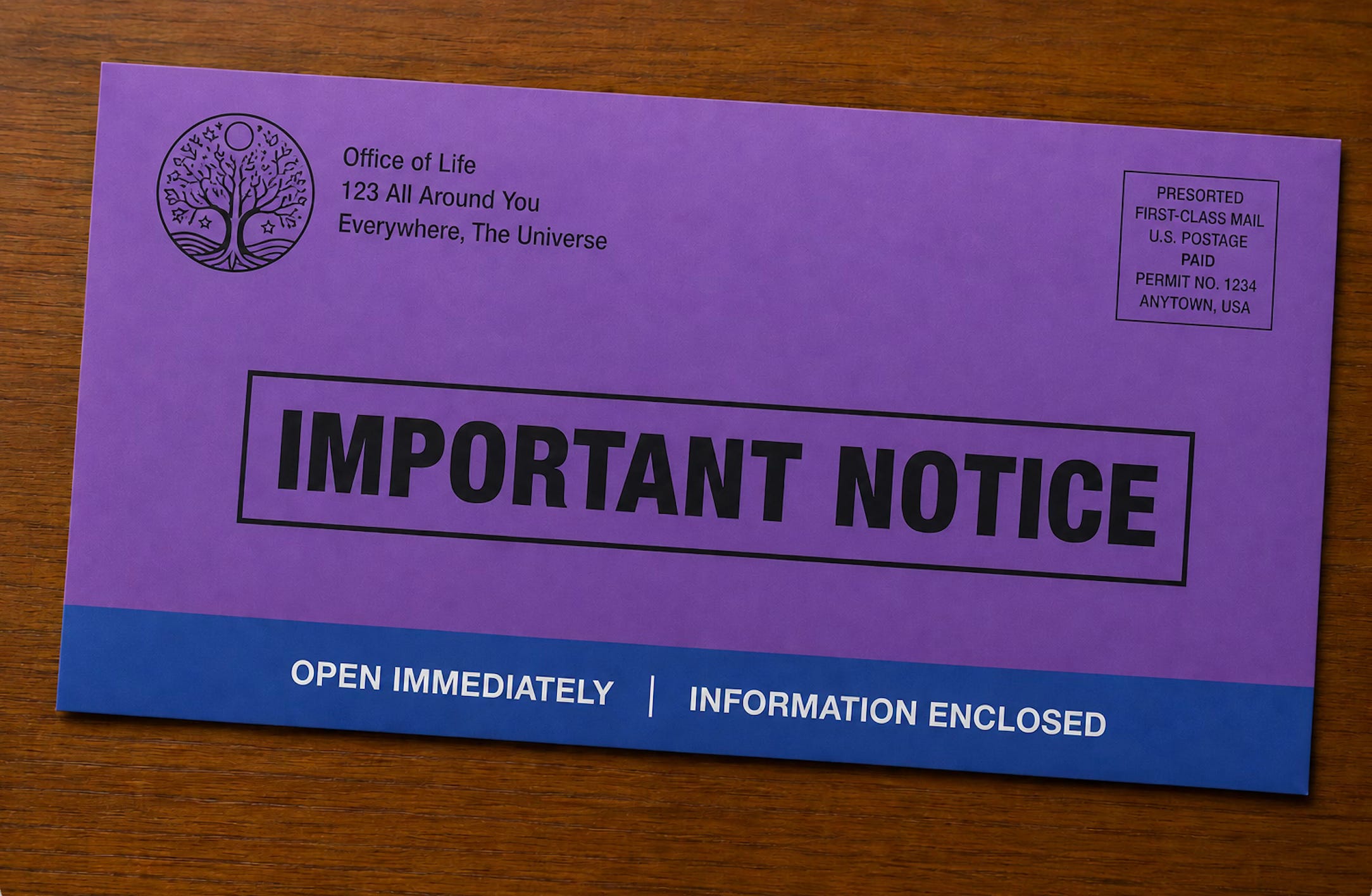
I’ve been thinking a lot about noticing. How everything in the universe—good, bad, mundane, spectacular—begins with noticing.
Someone you want to know? You have to notice they exist first. An itch you need to scratch? It has to draw your attention. A memory you want to relive. A place you long to go. A thought you care to develop. A problem to be solved. A fly you want to swat. A book you plan to read. An answer you need to find. A fragrance you wish to inhale. Before the want or need comes the noticing.
If we’re alive, we notice things. It’s how we experience the world. Like most skills, though, there are levels of noticing, different ways to approach it. We all have moments of passive noticing, of just allowing things to bubble up or seep or even slam into our consciousness. This is perfectly ok. If we tried to tune into every single signal or blip, we’d go mad. Even when there’s no incoming stimulation, awareness still rushes in.
I read about an experiment where subjects were put inside completely dark and silent rooms—anechoic chambers—where the total silence and lack of external stimulation became deafeningly loud and overwhelming.
Their heartbeats and breath and blood became thunderous. They lost their bearings and balance, became disoriented and panicked. Their minds and bodies supplied stimulus in the void. There was too much to notice in the absence of external things to notice. No one lasted more than one hour, and most lasted only a few minutes. The noticing became too much.
Is it possible to notice something without assigning (or attempting to assign) it meaning? It’s our nature to try to make sense of the world. To be able to explain or interpret everything we encounter. To categorize.
Some of the purest emotions or reactions arise organically, though. The way a baby’s toothless grin or giggle makes us smile. How a pile of puppies can light up a tender spot inside of us. How a photo of a departed loved one ignites a poignant pang. Natural and instant reactions, but first came the noticing of the baby, puppies, picture.
Writers are natural noticers. Always observing, absorbing, collecting details so we can kaleidoscope them onto the page. How the morning light through the gently swaying leaves casts feathering shadows on the ground. How the elegant older lady delicately holds her teacup, sitting tall and straight-postured in her chair. The swipe of weariness that brushes across the mother’s countenance, then disappears, as she smiles at the cashier. The intense swirl of pink from a rose glimpsed through a child’s bubble floating through the garden. The heavy rumble of the dishwasher providing an unacknowledged soundtrack to the couple’s frivolous argument. That the fifth brick in the fourth row of the wall is slightly crooked.
My grandad, my hero, once told me I was observant. It was an offhand comment tossed lightly to me in the backseat of the car on our way to a family function. I don’t remember what observation I had uttered to result in his assessment, but I do remember how the label landed on me like a shy and skittish cat choosing my lap to curl up in. I hadn’t asked for it, wasn’t expecting it, but I was pleasantly surprised and felt a bit chosen.
I’d never thought of myself that way, never used the word “observant” to describe myself, but I recognized instantly that it fit. The warm glow of being authentically seen—noticed—by another, especially one I adored and respected, felt almost sacred. The moment has stayed with me, lived inside me, all these years.
And now I’ve come to understand that noticing is another word for being present, for directing your focus outward to the universe around you. Not just a way to move through the world, but a way to be.
When we direct our focus outward, we allow more life to flow inward. When we become more open and expansive, the world responds in kind. We all have moments of zoning out, of being somewhere else or not all there. When you drive somewhere and can’t recall anything you saw along the way. Or miss part of a conversation because you were thinking about your to-do list. Or finished a page in a book and realized you have no idea what you just read.
Sometimes the mind goes places without us, but noticing, or being present, is a skill that can be honed like throwing pottery, speaking French, or changing a tire. What you focus on expands. The more you practice noticing, the more you’ll notice. You don’t have to be a meditating monk. “Omming” isn’t for everyone, but there are small ways, simple methods, for expanding your ability to be present.
I’m no expert—in fact, I’m barely a beginner—but I’m happy to share some ways that have worked for me. The first step is the simplest. You just have to decide that you want to expand your ability to be present.
The easiest way in for me is to settle into my senses, especially tuning into them one at a time. You can do this anywhere. Sitting in a coffee shop? Take a few minutes to focus only on what you hear. Go beyond the music being piped in or the bits of conversation around you. Listen to the whoosh of brewing equipment, the whir of a blender, the glug of liquid being poured, the tinkling of ice in a glass, the change in atmospheric sound when the door opens or closes. Waiting for an appointment? Instead of distracting yourself with your phone, take in the visual details all around. The textural pattern in the carpet, the color on the magazine covers scattered around, the glossiness of a chair’s legs, how many people are in the room.
Tuning into your senses can be done anywhere, any time, but there’s no better place to practice than in nature. I’ve made my trail walks into a sort of meditative practice by tuning into each of my senses individually as I go. Experiment with this type of awareness and see what resonates with you.
Another tool for noticing is stillness. By simply slowing down and dropping into ourselves, we become more attuned to the world around us. Sometimes we are able to take in the most when we are doing the least. Try just sitting and noticing. Again, it’s about where you direct your energy and attention. If there’s too much stimulation—or not enough—try directing your awareness to within your body. Feel your heartbeat with your hand. Concentrate on your breath. Focus on what your body feels like in the moment, one part at a time.
If you need a place to channel your observation when concentrating on noticing, try writing it down. You don’t have to adopt a formal journaling practice if that’s not your thing, but try taking a random moment to jot down every detail that rises to the surface of your awareness. You may be surprised by how quickly your list grows long.
Finally, to invite more awareness in, try a small change in perspective. Instead of spreading your awareness over an entire field of flowers, choose one to truly examine. Or a single leaf. Or a seed.
Practicing presence may feel challenging at first, but like tying your shoes or riding a bike, once it’s in your muscle memory, it will become organically automatic. By narrowing your focus, your world will open even wider. You might be surprised by the universe of detail that can exist in the smallest of things. It was always there. You just may not have noticed.



Great reminder to be present and suggestions for noticing. Sometimes I find myself sitting at my desk, staring at my phone instead of looking out the window when I'm in between whatever-the-F I'm doing or supposed to be doing. Nature walks and cycling force me out of the trance, but even then.... suddenly I'll realize I'm not really noticing the trees or sky. Working on it!
Great title Leslie that really grabs you to "notice" this piece.
I agree that as writers we naturally pay more attention to the world around us. I'm always taking a pic or jotting a note in my phone for something I'd like to consider expanding on later.
I like your suggestions and find my senses are heightened when doing my run/walks and walks too.
I also would suggest breaking up your routine to put yourself in a new place or situation to heighten your sense of noticing. I think this brings out the native New Yorker in me because my antenna goes up and I become extra aware. Safety first followed by "let's check this out!"