

A Hand Made's Tale
Sometimes It's About How the Words Are Made

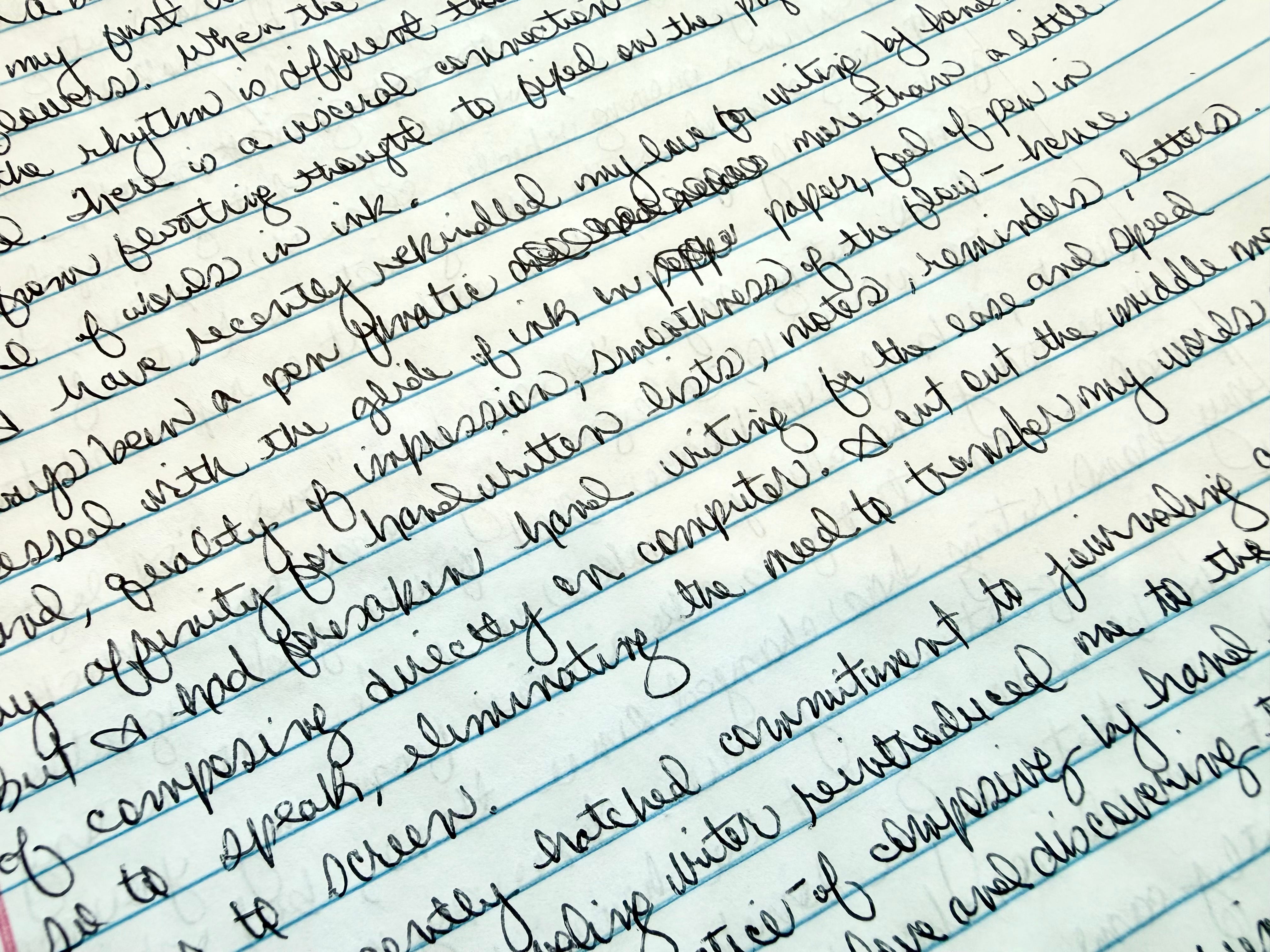
I sit at my desk in front of a window, my hands resting and still on a blank piece of paper, pen between my fingers, waiting for my first words to come and land like butterflies finding flowers. When the words do come (the ones you’ve just read) the rhythm is different than it is when I click on my keyboard. There is a visceral connection—an invisible thread that flows from floating thought to fixed on the page—as I leave my trail of words in ink.
I have recently rekindled my love for writing by hand. I’ve always been a pen fanatic, more than a little obsessed with the glide of ink on paper, feel of pen in hand, quality of impression, smoothness of the flow—hence my affinity for handwritten notes, lists, reminders, letters. But I had forsaken hand writing for the ease and speed of composing directly on computer. I cut out the middle man, so to speak, eliminating the need to transfer my words from paper to screen.
My recently hatched commitment to journaling after a lifetime as a non-journaling writer reintroduced me to the joy—and almost meditative practice—of composing by hand. It’s been like reconnecting with an old love and discovering the spark is still there.
Writing by hand is a sensory experience, each word its own little universe of loops, curves, lines, and flow. There’s an element of surprise to how each letter will turn out and the chance that a single word will never appear exactly the same way twice. Handwriting is personal too, almost as unique as a fingerprint.
As a girl, my heart always swelled at the sight of my grandmother’s graceful writing on the outside of an envelope. I’d know immediately it was a letter from her without having to look at the return address. Coming across anything written by my mom—an old note, her checkbook, a forgotten to-do list—brings her right into the room with me the same as if I caught a whiff of her perfume. My dad’s illegible doctor scrawl is instantly recognizable (if not decipherable) to everyone in the family. And my son has told me on more than one occasion that he’s always loved my handwriting and even tried to copy it as a child. This tidbit makes me disproportionately happy.
Handwriting is also conditional. It changes based on any number of factors: if your hand is shaky or cold, if you’re tired or weak, whether you’re upright or slouched, sitting still or moving, calm or anxious, hurried or languid. It changes based on the writing instrument itself. Ink on paper is quite literally fluid, which makes it a representation of a moment in time.
Handwriting says, “I was here” and “I left my mark.” When I was around 10, I signed my name on a brick on the front porch of our house. That fourth grade signature has endured all these years and still makes me smile. It’s a tiny little portal in time that feels like a wink from my younger self.
My handwriting has changed since then, but I’d know that bygone signature anywhere. Since my mom died three years ago, I’ve been renting out the house to tenants. I’ll be sad if I see that they’ve erased my signature off that brick. It would somehow feel like a loss.
I recently came across a Japanese study that correlated writing by hand with enhanced brain activity, memory encoding, and overall cognitive health. It concluded that writing by hand forces the brain to work simultaneously on multiple levels—movement, space, and memory—and offers a potential protective element against dementia.
Dr Hiroshi Tanaka spent almost a decade studying 300 elderly people (over 80 years old) who exhibited no signs of cognitive decline. Expecting to uncover some kind of genetic or dietary lifestyle link, he was surprised to find the one common thread was that every one of them wrote by hand for at least 15 minutes a day. “Typing uses one brain pathway,” he said. “Handwriting activates 17.”
This is particularly exciting news to me as someone who possesses the worst possible genetic marker for late onset Alzheimer’s.1 I already pay attention to lifestyle factors like diet, exercise and sleep. I do daily brain exercises and practice stress reduction techniques. Now I can consider my daily journaling sessions part of my prevention arsenal.
Even if writing by hand wasn’t mentally beneficial though, I’d still be a devotee. I find it soothing, almost sensual, and in today’s digital world, a bit nostalgic.
Of course, quick and convenient is sometimes preferable, so I won’t be saying goodbye to typing altogether. I’m just going to incorporate regular sessions of composing by hand into my writing routine, and I’m going to keep my morning journaling going. I’ll make writing by hand a habit, since I now know that sometimes the pen is mightier than the keyboard.



You can read about that here.

Wow. That was a revelation. I remember what I write by hand, but not what I type, so handwritten notes in class helped, but typing into a laptop didn't. I love my grandma's handwriting, her Eastern European roots are evident in her letters and numbers and she was my number one safe place. My father's handwriting was that of a psychopath. Seriously. I can't imagine writing my work out by hand at this point, but I understand that it changes the creative process, slowing things down, allowing for more thought, but lady, my hand cramps after a few sentences these days. My fingers have lost their memory.
Great essay as always.
My grandmother wrote 2 or 3 letters to me every week, so I felt the same as you when I got them in the mail. In fact, I had saved every letter I'd ever received from my college years on....lots of shoe boxes crammed full. Sadly, when I was evicted from my home of 35 years I wasn't able to keep them. It was traumatic, to say the least. I was able to save my journals....
BTW: I saw a study about nuns on PBS years ago. Those who wrote fared better in later years than those who didn't. I also briefly helped a man afflicted. Whenever I was with him, I played his music for him which perked him out of his fugue. A few times he actually sang along to the old tunes....magical moments for us both.